Monday, November 23, 2015

Production vs. Connection

As a composition teacher, I often wonder if my style of teaching is the best style for my students. In my department, we are encouraged to stress to our students that writing is not about the product, but about the process. While having a great initial product is fantastic, it is not realistic for every student to produce a wonderful and original piece of work. So, by pushing them to think in this way, students should be able to see their writing styles change a little bit through the semester. But, is that actually a good thing?
            According to Stuart Selber, my way of thinking would be associated with the “paradigm of production”. According to him, this paradigm “ teachers embrace process models and even the social turn that the discipline has taken, yet they ultimately expect students to produce a thoroughly original text, one in which their own…ideas and words become the discernable anchor of the discourse” (Selber 135). In other words, teachers expect originality while also at the same time urging them to interact with the real world. As a result, these students could be thinking that originality has no place in the world of academic writing.
            As an alternative, Selber discusses the “connection paradigm”. This particular paradigm allows people to “focus on reorganizing and rerepresenting existing (and equally intertextualized) texts—their own included—in ways that are meaningful to specific audiences” (Selber 135). A potential assignment for Selber would be writing a “hypertext that interprets and arranges relevant discussions of copyright for teachers of writing and communication” (135-6). So, with this line of thinking, teachers are allowing students to use original thought to figure out certain packets of information could be connected with each other.
            So, why aren’t more teachers using assignments that fall within the “connection paradigm”? I think it is because other disciplines are not encouraging them to think in that way. English/Composition is responsible for teaching the college writing, so the university believes that we have to teach it a certain way that can translate to multiple majors and schools of thought. Even though teaching writing with computers would be extremely beneficial to multiple students, that is not what we are there for. We are there to teach them how to do research and write academic papers and that’s it. That is why the process method still lingers in the composition world—because we are being hemmed in by the other disciplines. Until they see the purpose of doing a more interactive idea of writing, we will be teaching the basics.


Work Cited

Selber, Stuart A. Multiliteracies for a Digital Age. Carbondale: Southern Illinois UP, 2004. Print.

Sunday, November 15, 2015

The Impact of Constructivism on Literacy in a Computer-Free Classroom

           As I have discussed in multiple blogs on here, I do not have the privilege this semester of teaching in a classroom with computers for student access this semester. In a composition class, not having computers can be deadly especially if the department wants teachers to have in-class workdays to work on upcoming projects. I also know that I have students who do not own a laptop to bring to class, so that also becomes its own special issue. So, I struggle with showing students how to do certain elements on the computer when they do not have their own computers.
            That means that I fall in line with, at the very least, Stuart A. Selber’s definition of constructivism. According to him, this pedagogy “is a philosophy of learning based on the premise that learning is an active process in which students construct new knowledge based upon their current/previous knowledge” (76). In other words, I expect my students to be a participant in their own learning process. Even when I am lecturing from grammar PowerPoints, I want my students not only feel comfortable but also feel encouraged to ask questions about what I am teaching. So, when they are silent, it makes me feel like they do not care about what I am teaching, which is extremely disappointing to me as a constructivist teacher.
            So, how does my idea of constructivism impact specifically computer literacy in a computer-free classroom? A great way that I use this concept is if my students have in-class assignments that could be completed by using the Internet; I let them use either the Internet or their cell phones or other device that can access the Internet. That way, they can see that these devices that they use every single day (especially cell phones) can be used in an academic setting. By doing this assignment, students are able to combine the literacies they have gained throughout their educational careers along with the literacies they have gained from using cell phones and other electronic devices for so long. I am still working on strengthening this process, but so far it has worked really well in my classes. Are there any other suggestions to help me?
Work Cited

Selber, Stuart A. Multiliteracies for a Digital Age. Carbondale: Southern Illinois UP, 2004. Print.

Sunday, November 8, 2015

Review: Instant Identity by Shayla Thiel Stern


          So, in order to continue my own individual exploration of the fields of literacy and girls studies, I decided to read yet another book in this field. I chose Instant Identity: Adolescent Girls and the World of Instant Messaging by Shayla Thiel Stern. In this particular book, Stern looks at the Instant Messaging that several girls of different races, socio-economic classes, and religions partake in. Throughout the book, Stern highlights how these young ladies construct their identities through these online interactions with their friends. For example, one of the participants in the case study can have a deep and introspective conversation about Christianity with one of her church camp friends but then also have a flirty and playful chat with a guy that she likes. Stern also explores how services like AOL Instant Messenger exploit these young women in order to promote their own business.
            Unfortunately, this book has several flaws. First of all, Stern has very limited interactions with them, so she is heavily relying on the self-perceptions of the subjects instead of her own developed perception of them. Secondly, Stern barely acknowledges any other way of instant messaging. She does mention texting but drops it quickly because it is still novel at the time. Because of this lack, Stern’s book feels extremely dated even though it is only 8 years old. Finally, because Stern focuses on so many girls in this study, these girls do not have much characterization. I spent so much time while reading this book flipping back and forth to the introduction of these girls, so I can make sure that I knew who was who.
            Although this book doesn’t focus as much on literacy as I thought it would, I can still see it being beneficial to my own research. After all, this research shows how young girls and their literacies can be impacted by online pressure. If you don’t know the hip IM slang, you are noted by others as being inexperienced. I would love to see Stern do a more focused and updated version of this research, but instead of focusing on IM, she should focus on texting and emoji language. After all, more young women and girls do texting than IMing these days anyway.

Work Cited

Stern, Shayla Thiel. Instant Identity: Adolescent Girls and the World of Instant Messaging. New York: Peter Lang, 2007. Print.

Sunday, November 1, 2015

Why Having Computers is Important to Teaching Composition

            For two out of the three years I have been teaching college composition, I have been fortunate enough to have spent at least one class day a week in one of my department’s computer labs. Having this access to computers was great because I was able to give time for the student’s individual exploration of their writing or their research instead of assuming that my students have their own laptops or tablets. This year, I didn’t get so lucky because I ended up teaching Writing II, which isn’t taught in a computer classroom at my university. As a result, I feel like I haven’t been nearly as effective with developing a better computer literacy. My feeling is probably shared by many college composition teachers as a survey conducted in the early 2000s shows “that only 25 percent of the graduate teaching assistants in rhetoric and composition programs have an opportunity to teach writing in a computer-based classroom” (qtd. in Selber 7). Of course, this survey is dated, but I’m sure that many teachers are still in my situation. So, although Selber says that this lack to direct computer access shouldn’t be a barrier in teaching composition, but why can it be?
            I have two basic theories. The first theory is that students don’t have the time or the ability to have the direct interaction with the computers. In the past, I have taught how to do basic research and then allowed them to have some time to do their own research on the university’s computers. Without that ability, I am expecting them to listen to me teach and then go home and remember everything. That is just not realistic for even the most overachieving student. The second theory is that students just don’t see how applicable these computer skills are without actually getting the opportunity to test those skills out. English and composition are often seen as not important because they are not “applicable” in their lives, which is not true. We, as composition teachers, have to push our students to see that despite computers, we can still learn more about composition. However, I dread that with today’s technology-minded students, not teaching composition with computers could be the death knell for the modern composition classroom. Hopefully, composition departments will learn that lesson sooner rather than later.


Work Cited
Selber, Stuart A. Multiliteracies for a Digital Age. Carbondale: Southern Illinois UP, 2004. Print.


Monday, October 26, 2015

The Abilities of the Computer Literate Student

In his introduction for Multiliteracies for a Digital Age, Stuart A. Selber discusses several questions that should be on the forefront of the minds of composition teachers as technology continues to progress. One of these questions is “What should a computer literate student be able to do?” (Selber xi). This particular question got me to thinking about what are my expectations of computer literacy in my own composition classroom. In fact, I worry that I have too high of expectations for these students that I don’t explain in thorough detail how to do what I consider basic computer knowledge. A prime example of this idea is when I had to explain to my students how to attach files to emails by the using the paper-clip icon in Microsoft Outlook. What I thought was common sense was proven to be wrong. So, I decided to list the three basic abilities that in my head would count towards computer literacy. They are, to me:
  • Computer literate people should know the basics of operating a computer. I don’t expect many to know coding lingo, but I do expect them to know how to turn on a computer, charge it, and turn it off without asking for help. They also know how to mess with basic controls on the computer like sound and volume.
  • Computer literate people should be able to use some form of word processing software in order to type. In line with that, people should be able to save, print, and edit their work. This particular aspect of computer literacy would be this most relevant to the composition classroom because it shows that they can write papers using technology.
  • Computer literate people should be able to know how to access the Internet. Not only does this theory apply to what web browser to use, but also that people know how to check email, search for basic information, and keep in contact with friends along with other Internet skills.

Some may notice that I did not bring up other digital devices like cellphones and tablets. That is because most of the same aspects of basic computer literacy could apply to other forms of digital literacy. To me, there is not much difference. Do you agree?
Work Cited
Selber, Stuart A. Multiliteracies for a Digital Age. Carbondale: Southern Illinois UP, 2004. Print.

Thursday, October 15, 2015

Voice in Written Work

I know that I have written the following comment on many a student work: “I can/can’t hear your voice in your writing.” Although this may sound idiosyncratic to non-composition teachers, it makes perfect sense to me. After all, students who try to write in a pseudo form of academic prose can often sound like they are “faking it.” Luckily, one of the foremost figures in composition studies agrees with me. According to Peter Elbow, “The best writing has voice: the life and rhythms of speech” (189). Without these needed “rhythms of speech”, the writing feels stilted and not representative of the student’s best work. For example, imagine if there is a composition student who wants to write an argumentative paper about abortion. Although abortion is an overdone topic, the student may be able to bring their own perspective to the paper through two different avenues. The first one is that they can show their view of the abortion debate along with the research skills in order to build a compelling argument. The second one is that they have the writing skills to communicate that argument. Without one of these, the other one cannot bring the paper to the position that it needs to be. So, if the student is writing without “the life and rhythms of speech”, this paper will come across as fake and not truly expressing what the student is meaning to say. Instead, the paper will potentially read like a regurgitated abortion debate instead of a fresh take on a fairly dead topic.
            So what can composition teachers do in order to help with increasing more voice in written work? It’s extremely simple. Show them that using their voice isn’t wrong but necessary to take a stronger responsibility to one’s work. Increasing one’s voice may make your writing more vulnerable and risky, but it can also heightened the writing and argument. Yes, “inventing the university” is still important, but so is “the life and rhythms of speech”. One just has to find the right balance between the two.

Work Cited

Elbow, Peter. “The Shifting Relationships Between Speech and Writing.” Landmark Essays on Speech and Writing. Ed. Peter Elbow. New York: Routledge, 2015. 181-200. Print. 

Sunday, October 11, 2015

The Perceptions of Literacy in College Students

     After finishing Chasing Literacy by Daniel Keller, my eyes were opened wide by how today’s students have to be able to adapt in using multiple literacies in the classroom or risk the chance of being left behind by an education system that swore against that very practice. Throughout this fantastic case study, Keller details the successes and struggles that students can have when literacy not only has multiple meanings but also has multiple practices. In the conclusion, Keller notes how “perceptions affect what people do with literacy” (161). I have to agree with that assertion from personal and teaching experience. Before taking a class in literacy theory, I had the naïve belief that literacy just related to reading books and writing academic papers and short stories. However, that is not all that we read and write. Every day, we read and write text messages, social media posts, and television listings, not to mention all of the reading and writing that is needed for school purposes. But, this quote, along with the rest of Keller’s work, got me to thinking about how my own students would respond. After all, I teach upperclassmen that would not fall into the same trap that I did, right?
            So, I decided to ask my students two very simple questions. The first one was “What do you read on a regular basis?” The second one was “What do you write on a regular basis?” I was clear that I would not aid them in answering these questions, because I did not want to lead them into answers that would prove Keller correct or incorrect, thus rendering this “experiment” invalid. But, there was no reason because they answer as Keller predicted. According to the majority of these students, the only thing that they read is textbooks and other school materials and the only thing they write is papers and other homework assignments. Some of them mentioned texts and social media, but not all of them did. When I brought this up and asked why they did not mention the other “non-academic” literacies, they said that they were writing down what they thought I wanted to read. Imagine their shock when I reminded them that I just wanted to know what they read and write on a regular basis.
            What does this all mean? It means that in this ever-changing world, people do not realize how much we read and write. It also means that they have more chances to improve their reading and writing skills along with other abilities that will allow them to become better readers and writers. So, as a teacher, I will have to work on constantly reminding them that they read and write more than what they think they do. I will also do a better job of bring multiple literacies into the classroom in order to make learning how to write better more grounded in reality.
Do you have any tips for me?


Works Cited
Keller, Daniel. Chasing Literacy: Reading and Writing in an Age of Acceleration. Logan: Utah State UP, 2013


Monday, October 5, 2015

"Paying Attention" to Technology

While reading Cynthia Selfe’s “Technology and Literacy: A Story about the Perils of Not Paying Attention”, I was struck by many of Selfe’s findings about how privileged certain groups are to have the luxury of developing technological literacy. However, the one line in the article that caused me to start thinking about my role that was when Selfe argues that “composition studies faculty have a much larger and more complicated obligation to fulfill—that of trying to understand and make sense of, to pay attention to, how technology is now inextricably linked to literacy and literacy education in this country” (414). I hadn’t thought much about how my use of technology could increase the technological literacy divide in my classroom. Sure, there have been circumstances when my students have struggled with technology that I assumed that they wouldn’t have. For example, last fall I had to do a tutorial about how to send emails with attachments after a few students complained that they couldn’t figure out how to send their projects to me.  But, I thought this wasn’t the norm. However, once again I was proven wrong about one of my assumptions about teaching college composition and that there will be many students who struggle with technology.
                After all, the make-up of college students is very diverse, so naturally the make-up of technological literacy is going to be diverse. For example, I will have students who have not only grown up using the Internet but have actively been taught in using it properly for a long period of time alongside students who had their first experience using the Internet when they first started college. So, many people are going to ask, “How do we pay attention to technology and literacy in regards to teaching?” I think there are two big steps to paying attention. First of all, listen to what your students are having issues with. If it is something basic, like email or PowerPoint, take time after class or during your office hours to help that particular student out on an individual basis. Otherwise, you will have students complaining about how elementary this problem is. But, if the issue is more advanced, then maybe you can make a lesson in order to help bridge the gaps of literacy. Secondly, do more lessons that deal with writing using technology. For example, I am having my student write an appropriate email to a college instructor this week for a journal assignment.  That way, they can learn not only the proper way to communicate to an authority figure, but they also can get more familiar with the proper standards of writing an email. By doing this particular step, you are still teaching composition, but you are also teaching technology.
                Do you have any feelings about our lack of “paying attention” to technology?
Work Cited

Selfe, Cynthia L. “Technology and Literacy: A Story about the Perils of Not Paying Attention.” College Composition and Communication 50.3 (1999): 411-436. Web. 

Sunday, September 27, 2015

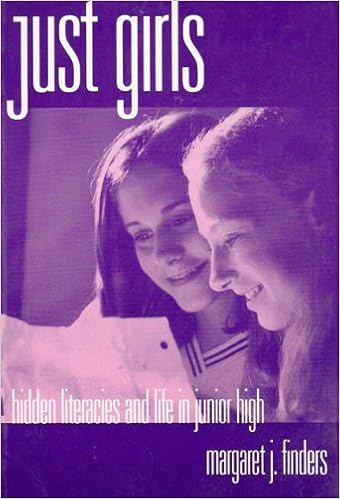
Review: Just Girls by Margaret Finders

           
In order to expand my knowledge of literacy theory, I decided to do some additional reading on the subject. The first book that I chose to read for this purpose was Just Girls: Hidden Literacies and Life in Junior High by Margaret Finders. For this particular study, Finders followed primarily five girls “in their transition from a self-contained sixth-grade classroom into a traditional junior high setting” (2). These five girls belonged to two different social groups in the junior high. Angie, Lauren, and Tiffany are considered “social queens” while Cleo and Dottie are “tough cookies”. The “social queens” are described as the popular girls while the “tough cookies” are considered the good students while also not active participants in the social aspects of junior high. The primarily focus of following these five women for Finders is to find more about the literacy habits of the junior high aged female.  What is really interesting about focusing on these two specific groups is that their literacy activities are completely different. For example, the “social queens” live for the opportunity to sign yearbooks for those deemed worthy to have this privilege. On the flip side, the “tough cookies” do not get to participate in that activity because their families cannot afford a luxury like a yearbook that will only have the standard picture of their daughters. Finders also delves into these girl’s literacy identities. For example, Angie is the stereotypical “smart” one amongst the “social queens”. Therefore, Angie not only has to keep her grades up, but she has the responsibility to sell her papers to her friends in order to keep her social status. Cleo, one of the tough cookies, grew up in an environment full of books which allowed her to escape her life.
Finders does an excellent job of showing how all five of the girls interact differently with literacy. It also makes me want to explore this genre of girl literacy further. After all, females have a much different view of literacy than males do, which largely develops in junior high. Since females have always been stereotyped with being "Chatty Cathys", I would love to see if these conversations are tied to their ideas of literacies. If you are interested at all in literacy or junior high studies, I highly recommend checking this book out. In fact, I would love to see a more modernized version of this book that includes how these junior high school girls expand their literacies from the use of the Internet or social media. I would also love to see a book where Finders return to these five girls later to see how their ideas of literacy has changed or stayed the same.If you know of any studies in that field, please let me know.
Works Cited
Finders, Margaret J. Just Girls: Hidden Literacies and Life in Junior High. New York: Teachers College, 1997. Print

Monday, September 21, 2015

Disabled Literacy?

            I thoroughly enjoyed reading “What No Bedtime Story Means: Narrative skills at Home and School” by Shirley Brice Heath. In this particular article, Heath analyzes the home literacies of families from three communities: Maintown (just the average American town), Roadville (a predominately white town that thrives on a mill), and Trackton (a predominately black town that thrives on a mill). While doing her research, Heath was focusing on how these three communities define certain childhood events. Although the full article is interesting, one area in particular really caught my attention. While talking about Maintown, Heath discusses the “Maintown ways”, which Maintown kids “were expected to learn….in these nuclear households” (52). Although these literacy steps would be great for a child who was considered “normal," what about those who were not or could not be considered “normal." I am talking about personal experience here because I did not speak until I was 3 or 4. As a result, despite the fact that I was basically reading when I started to talk, I would be behind according to these “Maintown ways." For example, I would not be able to “announce [my] own factual and fictive narratives” (Heath 53) because I was not able to talk.

            Deriving from my personal experience, I went down the rabbit hole of thinking about how the definitions of literacies would differ from those who suffer with disabilities that would disrupt their normal development. After all, those are visually impaired would not be able to “give attention to books” (Heath 52) because they cannot see the book or literacy material and those who are deaf cannot “listen and wait as an audience” (Heath 53) to a book. I do not want to be hard on Heath’s research: after all, it was published in 1982 and the field of disability studies was still in its infancy. But, this is a crucial lapse in Heath’s research that is so glaring to me. I had to do some primitive research into how those afflicted with disabilities define literacy and was able to find a good website called Perkins Learning. This website offers plenty of resources for those looking to improve the literacy skills of people with disabilities. According to this website, “literacy may call for options other than Braille or print” (“Literacy Students Multiple Disabilities Deafblindness”). Maybe the openminded nature that allows for multiple literacies also expands the definition for literacy. I guess the biggest takeaway from doing this little bit of thinking and research was that I want to keep looking into this. That way, more literacy theorists can realize that their research is not encompassing for everybody.

Work Cited
Heath, Shirley Brice. "What No Bedtime Story Means: Narrative Skills at Home and School." Lang. Soc. Language in Society 11.01 (1982) 49-76. Web. 

Monday, September 14, 2015

Do You Dual Credit?

            Throughout Chasing Literacy, I have constantly been reminded of my high school literacy experience. So much of what these case study students have been saying was what I would have said at seventeen. Another grim example of how this case study mirrored my real life was the idea that college composition courses could actually be taught in high school. According to Kristine Hansen and Christine Farris, these courses are rendered “appropriate to move into the high school to speed up student development and make room in college for other kinds of learning” (qtd. in Keller 84). It would be an understatement to say that I have problems with their assertions. First of all, Hansen and Farris feel that the high school classroom is “appropriate” for an accelerated version of a college composition class. When I think of college composition courses, I do not always think of a safe and watered-down environment like the high school classroom. From my high school experience, I never had a class that would have translated well into a college classroom. After all, these college courses taken in high school (often known as dual credit classes) can feel like they are watered down since they have to meet the college standards for a high school mind. Also, these dual-credit classes have to be available to every student that wants to take it, not just those who would do well in these classes. So, a rigorous college course gets translated to become an ordinary high school class that will get the student college credit. Thus, the college composition course is no longer the same thing. The second issue I have with Hansen and Farris is the fact that they are implying that composition courses are not a necessary component to college learning. Now, I understand and agreed with the line of thought that some people need to learn writing skills in high school, but I still think that college composition courses can help learn other skills that are necessary. I know that I have taught how to write an email, register for classes, and drop classes to students on top of writing an argumentative essay for the appropriate audience and crucial researching skills. By saying these classes can be taught in the high schools, people are limiting the options for first year students to become more engaged in the collegian atmosphere.

Any other problems with the Hansen and Farris quote? Or, do you agree with the Hansen and Farris quote?

Works Cited
Keller, Daniel. Chasing Literacy: Reading and Writing in an Age of Acceleration. Logan: Utah State UP, 2013.

Monday, August 24, 2015

Welcome to the New and Improved Blog!

                I will admit it-I have kept a few blogs in my day. Usually these blogs were my ramblings on pop culture, so nothing terribly serious. But, this past semester, I started a blog on my growing understanding of composition and rhetoric as part of a class assignment. Despite the dread that comes with being graded on your personal thoughts, my blog became something else to me. It became a place to become an active scholar in the field of composition and rhetoric, a field that I once scoffed at. Throughout graduate school, that attitude changed into one of enthusiasm. That is why I am really excited to continue my blogging adventures this semester, but with a twist. This semester, I will be looking at how literacy theory interacts with composition. But, changes to the content of the blog means that I have to change the formatting of the blog.
                The first and biggest change that I made was the name of the blog. The name was previously “The Grad Student Chronicles” since it focused at first on my responses to assigned readings. But, I neglected to change the name once it transitioned into discussing my work as a composition teacher. I knew that I had to rectify that mistake for this semester. The blog’s new and better name is “The Composition Chronicles”. I chose this name for two simple reasons. The first reason is that “chronicles” brings to my mind a diary or a journal without being so blatant. The second reason is that all of my previous, present, and future blog entries are tied to composition. So, I figured I would just have composition in the title, so visitors to my blog will not be confused about the subject matter. I know that blog titles need to be truthful or you will have angry blog readers on your hands!
                I decided to keep my blogging activity on Blogger for a multitude of reasons. I have done almost all of my blogging activity on Blogger, so I am extremely familiar with it. Blogger also allows someone who wants to keep his or her blog simple (like myself) to do so with no pressure. But, Blogger also allows you to learn more about the different templates, so you can make the blog the way that you want it. I really appreciate the fact that Blogger allows you that flexibility since I have to have a small learning curve in regards to aesthetics. I also like the mobile app option so I can, if I need to, blog on the go with my iPad about my studies with literacy theory. Blogger also does pretty well with allowing me to place videos and pictures in my blog. These additions may not look the best, but they are functional and help to make the material more accessible for the modern blog reader. Finally, I wanted to keep all of my previous blog entries because they still have the subject matter of composition. Why delete them when they are still relevant?
                As previously stated, I like to keep my blog simple. Too many frills would ultimately lead to my own confusion, and if I am confused, then my readers will be confused, which isn’t good. I would also worry about being able to update it all the time. So, in regards to the theme, I decided to just tweak the theme that I had already had. This theme, Simple, is the basic theme available on Blogger but you can modify it to your heart’s content. My major changes involved adding two columns (one on each side) and adding two more gadgets, Labels and Favorite Links. The Labels gadget allows new readers of my blog to see common trends in my content. The Favorite Links gadget is a handy tool that allows me to highlight my favorite sites that may also interest my readers. These gadgets and columns also go with my theme of making things simple. After all, I am going to be discussing some heady stuff, so I need to make accessing my content an easy and painless process. I have also changed the color to red. Red also seems to bring up emotions like passion and excitement. Since I am passionate and excited about sharing my love for composition and rhetoric, I figured it would be a natural fit. Red also allows for the white font to stand out and be easier to read. I also decided to do a minimal background design that wouldn’t be distracting but still eye-catching.
                In order to continue this mission of keeping it simple, I have decided to not tab. On the same page, I have also decided to only have one page. I have already mentioned my concerns of being confused and tabbing would just be too problematic right now. I am not opposed to it, but I don’t see the purpose for it if I am just blogging. If I were to add a page about teaching or my CV in the future, I would definitely have to have it.

                Looking through my decisions in updating my blog, one thing stands out: simplicity. I want my blog to be simple. Now, some may see that as laziness. After all, Blogger has so many cool options, so why should one stick with the basic theme? But, I do the simple theme because I want my words to be the standout feature of my blog, not some cool template. I think that goes along with my strong written literacy and my weaker graphic literacy. But, as I continue to become more literate with graphics, my blog can change. I also notice how important my 21st century literacy skills are to this blog. Not only do I mention being excited about having new entries and media on my blog, but I also mention the potential of using the app. Obviously, I feel extremely comfortable with this skill set or else I wouldn’t mention it. But, I also prove with the changes that I made to my previous blog that I am constantly improving my literacy skills. This blog entry is only the beginning of my journey into understanding literacy theory. Join me, won’t you?

Thursday, May 7, 2015

My Sample Online Course Module

As this semester wraps up in my Teaching Writing Online class, I was asked to put together a sample module. I decided to do a module on Argument/Rhetorical Analysis, since it tends to be the hardest yet most rewarding part of Writing I. So, I had to do some thought about how I was going to set up my module. 
Directions for Access:
I completed my course module using the Blackboard shell from one of my former classes. If you click on the Courses tab in the right hand corner, the new page should have a “Course Search” function in the top left hand corner. In order to access my class, you must put the following course code in correctly and fully into “Course Search”: ENG-110-001-Fa14: Writing I. This search should only call up my class. Just click on that row of information and you are at my course module. Once you are there, you will need to click on “Argument/Rhetorical Analysis” to see my module. Let me know if you have issues accessing it!
Delivery:
For the purposes of this assignment, I decided to use Blackboard. There are three great reasons why. The first reason is that Blackboard is the interface that I feel most comfortable using. Even though it has its snafus, it is still a fairly easy interface to understand and use. The second reason is that it is the interface that my university uses. So, in all likelihood, I will probably have to use Blackboard for any online teaching at this particular university. The third reason is that Blackboard offers a lot of tools that are handy for teaching writing online. If one was to use Blackboard, he or she would have access to blogs, wikis, discussion boards, glossaries, and other numerous class tools. Instead of having to do multiple accounts over multiple websites, the majority of this course can take place in one spot, which is extremely handy. Blackboard is a closed and password protect site, which works really well for my purposes. After all, most first year composition students do not feel comfortable sharing their work at first. By allowing them write to private with some audience awareness, the students can grow comfortable with their writing.
Structure:
This particular module will be towards the end of the semester. So, in a traditional 16-week semester, this module would fit in on Weeks 12 and 13. This is also the project after their 8-10 page researched argument (commonly referred to as Project 4). As a result of it being after that kind of project, I will not be going into great detail about the rhetorical triangle of ethos, pathos, and logos in this module because that would have been discussed in an earlier module of this hypothetical course. But, the students should be able to bring the awareness of those three elements to the rhetorical analysis of P5. 
In light of how I decided to split the class into modules, I have decided to make the modules into separate pages that are easily accessible from the menu on the left side of every Blackboard site. That way, all of the information can be found on the module page that it was discussed in. This layout was done to make it easier for my students. I also didn’t try to make the Blackboard background too busy because it shouldn’t distract students from the purpose of the class. I did decide to do a bold red background, because it makes the site look exciting and bright, instead of looking cold and sterile. The most important decision I made about aesthetics though was about the layout of the class. For this particular module, I decided to put all of the information about Argument Analysis into a folder and all of the information about Project 5 into a separate folder. The items that pertain to the whole module in general, like the journal and discussion board, were left out in the open because they are items that have a deadline but can be done at any time.
Ecology 
For this particular module, I have decided to use Journals, Message Boards, and Twitter as my three main tools. I picked Journals because it is a way for students to engage in that private writing for a specific audience that I discussed earlier. Message Boards, on the other hand, is the way that students can interact with each other. By creating threads that have them discuss common topics like the readings and projects, the students will be able to communicate with each other. They will also have a chance to do asynchronous yet engaged conversation about the subject matter, which will help them understand the material even better. Twitter allows for conversations to happen in real time or later on. Even though it only allows for short 140-character thoughts, it can still be useful when students have a question. Message Boards and Twitter would allow my students to interact with each other by responding to each other and giving them ideas and feedback. Taking an online class can make someone feel isolated. By ensuring that I use community-building tools, these students can feel welcomed and wanted.

Reflection
I think I achieved all of my goals, but I do not feel satisfied with this module. I can see things I need to change. The video I made for my students to practice Argument Analysis on is rough with amateur edits. However, it was my first time using Windows MovieMaker and it took me 2 hours to do a minute-long video. I am considering redoing the peer review process. Email may not work well, but Blackboard tends to crash, so either way, peer review can fail. I also feel like I need to more, but I am scared of adding too much. I am aware that Argument Analysis is tough to understand, so I didn’t want to put too much on them. Do you all have any thoughts on my course?

Wednesday, April 29, 2015

What Would Be Included In My Syllabus?

Throughout this semester, I have pondered how my current writing class syllabus would change for an online environment. I know how crucial a syllabus can be to any class environment. After all, it describes the expectations for any students in my class. Scott Warnock agrees with this assertion and emphasizes the importance of the syllabus as the first written communication that the students will have with the teacher. According to Warnock, “ written text will still likely be of primary importance in their understanding of what your course is about, how they will be evaluated, and what your expectations are for them” (38). So, in other words, that syllabus is what ultimately sets the tone for the rest of the semester within the course. So, with this in mind, I have decided what to include in my hypothetical online syllabus. These following elements are absolute must have in not just my online syllabus, but any online syllabus.

Office: I still plan on hosting office hours, even if my students live hours away. After all, office hours are crucial for any student to come in and ask questions. I also plan on hosting virtual office hours, so that I am available to my students in person and through Skype.

Email: In an online course, email is going to “be a primary mode of communication” (Warnock 40). A specialty in any of my syllabus is including a clause about proper email etiquette. I have seen so many informal emails that I have to say in my syllabus that I expect to be addressed in a proper way and not “Hey Dude!” I also plan on including a clause that any email sent by 10:30 PM will be answered the following day. That way, I do not have to spend late hours waiting on desperate emails from students who waited until the last minute to do their major research project.

Escape Clauses: Sometimes, in online courses, students can get easily disengaged and discouraged. After all, there is no one that is an “active” presence in the classroom, reminding them of important due dates. That is why, I will aim to include those key drop dates in the syllabus. That way, they do not have to go to the university website to find out when is the absolute latest that they can drop the course.

Rules for Incomplete or Late Assignments: I will have very clear deadlines for incomplete or late assignments. Although I will be a little bit more flexible as an online teacher versus a face to face teacher, I still want to stress to my students the importance of turning assignment in on time.

Skill Sets: I want to ensure that my students have as level of a playing field as possible. That is why I want to make sure that my students can operate Microsoft Word and are willing to become familiar with the University Library website in order to be able to succeed in my class. After all, knowing how to set up a document and do basic research is the foundation to any writing course.

Technology Excuses: I know, computers tend to “go to the big Apple Store in the sky” right before a major assignment is due. But, there has to be some sort of accountability. That is why I will not accept any late work due to not having Internet access or a computer. I come from the school of thought that if you are enrolled in an online course, you should have access to a computer or the Internet. If this is an issue, I would probably recommend that that student should probably drop.

Although the syllabi for online courses may require some clearer languages and higher technological expectations for students than the syllabi for face to face courses, the syllabi are basically the same thing. After all, the courses should have the same material. They are just taught on different medium. With this in mind, it does ease my mind a little bit

Comment Question: What are requirements in your hypothetical online syllabus?

Works Cited

Warnock, Scott. Teaching Writing Online: How and Why. Urbana, IL: National Council of Teachers of English, 2009. Print.

Sunday, April 26, 2015

To Skype, or not to Skype—that is the question

In any classroom environment, communication is extremely important. After all, if the teacher becomes checked out in the course, chances are that the students will too. The importance of communication increases when the class is online. After all, there is a high chance that the students and the teacher will never meet, given the circumstances. So, for the most part, face to face communication is entirely out of the question. So, the teacher has to think of many alternatives to ensure that students are not afraid to discuss something with their teacher.
   Many teachers will automatically reach for that device that seems to becoming another limb for everybody—the phone. I personally do not like talking on the phone partially because I feel that I am not communicating to the best of my abilities. These phone calls are to people that I know; I would hate to imagine talking to my students over the phone and having two sorts of pressure on me.
   That is why if I teach online writing classes, I plan on using Skype has become one of the main ways that people are communicating online. In fact, Skype has joined that illustrious group of websites that have had their name become a verb. Anyway, I plan on using Skype for the variety of communication tools that it uses. That includes:
•    Video chat
•    Text chat
•    Conference calls
•    Sharing of files and/or images
All of these tools are extremely useful for teaching writing online. I could use video or text chat to have virtual office hours with my students. If I need to meet with a specific group of students, I could always do a conference call with them. That way, we would be able to discuss the issue all at once. The sharing of files and images can become extremely beneficial when students are trying to revise projects but desperately need help with it. Skype is definitely a great tool to have for teaching any class online. Skype is also very easy to use for anyone who is familiar with working online. It has also has apps available on almost every major electronic device out there. What could possibly be wrong with it?
   Unfortunately, there are a few disadvantages to Skype. First of all, Skype has a paid version that students may feel pressured into buying. Even if the free version of Skype has the essential tools that I will need for my classroom, students may feel that they have to buy it in order to possibly impress me about their commitment to the class. Secondly, not all students have the same amount of Internet availability. Some may live on-campus, so they do not necessarily have to worry about going over on their Internet allotment. For other students, that is a high concern. I completely understand, because I am one of those students who have very limited Internet access at home. I also know what it is like to want to use those cool websites that absorbs all of the data in the Internet plan. These “cool websites” include Skype with its multitude of necessary tools to succeed in the online writing classroom. These two concerns can be extremely detrimental to an online student, but these obstacles are easily overcome. Just tell your students that they only need to get the free version of Skype for the purposes of this class, but if they want to buy a different version of Skype, that is their decision. Also, make sure reiterate to students that they are not required to use Skype at all times, but if they have questions, Skype is the gateway to getting an answer.
   Overall, Skype (in my opinion) is an extremely worthwhile tool to have in the teaching online arsenal. It is hard to ignore the many avenues of communication that Skype has paved since its creation. If you can only have one tool to have virtual office hours, Skype is the best bet.
Works Cited
Skype. Microsoft, 2015. Web. 24 April 2015

Thursday, April 9, 2015

How Do You Solve A Problem Like "New Media Texts"?


I will admit it; I am still struggling to feel comfortable incorporating 21st century literacies in my seated writing classroom. I am trying though to get over my fears about this “new-fangled” idea.  After all, my two previous experiences with “new media texts” in my seated courses went well enough. But, I am so used to the “old school” ways of receiving and transmitting information that I may be biased against these new texts and, as a result, may not give enough thought to how these texts could be a great asset in my teaching.
However, I need to get used to the “new ways” that my students and other composition teachers are using. After all, according to Cynthia L. Selfe, “teachers of composition may be paying increased attention to new media texts because students are doing so-and their enthusiasm about reading/viewing/interacting and composing/designing/authoring such imaginative texts percolates through the substrata of composition, in direct contrast to students’ laissez faire attitudes towards more conventional texts” (44). Going back to my blogs on my students’ reactions to my use of Serial and Survivor in the composition classroom, I can see how this is absolutely true. Indeed, the conversations about these two texts were easily the best class conversations I had this semester. After all, as Selfe points out in “Students Who Teach Us”, “new media literacies may play an important role in indentify formation, the exercise of power, and the negation of new social roles” (Selfe 51). So, if I am able to effectively use “new media texts”, I can actually ensure that my students are able to grow and develop not only as critical thinkers and writers, but as people and citizens of the world as well. That idea is such an intense pressure to put on my shoulders, but I must be able to embrace it since I am a teacher.
So, how do I use “new media texts” effectively? Luckily, Selfe gives so much good advice about this for the uninitiated and tentative composition teacher. Her first step is to recognize the “whole range of literacies that students bring to the classroom” (Selfe 57). So, in order to be an effective composition teacher, I need to realize that my students have acquired their knowledge of “new media texts” in different environments. For example, some of my hypothetical have always grown up with a computer and a pathway to the Internet in their homes, while others still may not own a computer or an iPad. Recognizing this element is crucial in the composition classroom because it automatically disrupts any assumptions I (or any teacher) may have about the classwide understanding of “new media texts”.
Now, how do all of these ideas about using “new media texts” translate to teaching Writing I (a.k.a the writing class that everybody has to take)? Obviously, some of the assignments that Selfe herself recommends don’t neatly translate to teaching the basics of academic writing, but the principles can be addressed through individual activities. For example, one of the weekly journals can be a literacy narrative that only addresses their written literacy but their technological literacy as well. Another example of using “new media texts” is not doing just written texts as “reading” homework but using TEDTalks or other podcasts as the homework for that week. A suggestion that I have tried as a class activity is having my students watch a particular Youtube video (a particular favorite of my students is this one due to the humor and ease of language) and then having them do an argument analysis to figure out the video’s claim, reasons, and foundations. If you have any suggestions to help someone who admittedly a little scared of using “new media texts” in her classroom, please let me know. As of right now, it is a slow but necessary transition into using this technology. After all, I do not want to be the teacher that is left behind and still talking about Friendster and MySpace while my students are on their (hypothetical) hoverboards.
Works Cited
Green, Hank. “How to Name a Baby Properly.” Online video clip. Youtube. Youtube, 2 March
2011. Web. 29 March 2015.
Selfe, Cynthia L. “Students Who Teach Us.” Writing New Media. Eds. Anne Frances Wysocki, et al. Logan, Utah: Utah State UP, 2004. 43-66.

Wednesday, March 25, 2015

The Class Has Spoken: Teaching “Survivor” in the Writing Classroom


This past Monday, I had both of my classes of first year composition students watch the first episode of the 30th season of Survivor (aka Worlds Apart aka White Collar versus Blue versus No Collar) entitled “It’s Survivor Warfare” to look out for ethical implications. Although the reception wasn’t as warm as when I taught the first episode of “Serial”, a lot of my students liked it. They had a “reading” quiz to prove that they watched it which also comprised a few questions of critical thinking. One question asked who would they have eliminated and why. Another question asked, with a sole basis on this episode, who would be the “Sole Survivor” and why. The results I got were interesting.

For the question on who would they have eliminated, here are the results:

So-13

Carolyn-8

Joaquin-4

Shirin and Max-3

The students chose the particular people due to lacks of strength, trust, and loyalty. Some were also chosen due to being considered too much of a threat later on in the game.

Here are the results to the question of who they would think is the Sole Survivor:

Joe-12

Mike-5

Tyler, Jenn, and Will-3

Max and Kelly-2

Joaquin, Hali, Vince, and Carolyn-1

These people were chosen due to strength, likability, strategy, and camera time, amongst other reasons.

Overall, I would recommend using the first episode of any Survivor season to teach ethics. After all, Survivor is a game that is fraught with so many ethical decisions. Who do I vote out? Who do I make an alliance with? By asking your students to place themselves in the role of the castaway (minus the starving), it is interesting to see how they react!

Monday, March 23, 2015

Out-teach, Out-learn,Out-write:A Preamble to Teaching "Survivor"

After my success with using the popular podcast "Serial" in the classroom, I have decided to do another experiment with multimodal texts. I had my students watch the first episode of the latest season of Survivor (available here until Wednesday, the 25th) and think about ethical issues that are inherent in the episode. Since my classes haven't met yet, I cannot report about the success or failure of this experiment just yet. I will be blogging later this week to talk about how "Survivor" went over for in the regards to their quiz and to their class discussion. If you have any suggestions, feel free to share them in the comments!

Tuesday, March 10, 2015

Which Assignments Would I Use in My Online Writing Course?

I have become used to teaching my two seated sections of Writing 1 since I became a Graduate Teaching Assistant. As a result, I am used to the standard assignments that come with the Writing 1 class like journals, quizzes, and peer reviews. But, as I am interested in teaching online sections of Writing 1, I have to figure out which assignments I would be interested in using for my particular class. As is my standard, I will be taking the advice that Scott Warnock gives in his book Teaching Writing Online about the assignments that teachers should pick for teaching online:
     The ability to use many informal assignments can create a risk-friendly environment in which   students can develop their writing, which is a function both of what the students are doing and of the way we look at and evaluate their work. Because they write so much online, we can free ourselves from tendencies to focus on error in our students’ writing, because each assignment itself is only a small piece of that monolithic grade we must administer (94).
With that in mind, I have to pick assignments that would be worthwhile to both them and me. I have already started to think about this crucial decision, so here are my tentative answers.
•    My absolute must-have assignment is the weekly journal. It works really well in my seated courses, so it is extremely easy to translate to an online writing course. By having the students keep up a journal about their reactions and comprehensions of their reading and writing assignments throughout the class, they will be able to see how they are progressing in their development of being a better critical reader and writer. This journal could encompass several avenues of thought. I like metacognitive journals that analyze how the students think about reading and writing. I also like the rhetorical journals to make sure that they are able to understand the rhetorical strategies that they will have to employ with their own researched argument.  
•    I will have to have message boards for my online writing course. After all, message boards are able to create a deeper sense of community. Due to the fact that they already have weekly journals due, I don’t know how many posts that I would require them to have for a grade because I do not want to weigh them down with homework for this class. However, with the message boards, I really like the homework assignment that Warnock mentions called “My Favorite Post” (97). This particular assignment has students designate their favorite message board post and then explain why they say that it is their favorite. By doing this particular assignment, students would be able to become better critical thinkers while also learning to use evidence to back up their claims, which will make the students better at writing argumentative and persuasive writing.  
•    My final must-have assignment would be peer reviews. Although peer reviews can be analyzed in its own special blog post (which may happen, who knows?), I think it is a must have for any writing class, regardless of the environment. It teaches students to not only give thoughtful feedback, but how to receive it as well. It also helps them to become better thinkers and readers about what they are reading.
Overall, the thought of teaching online writing is scary at times, I think that with the aid of these particular assignments, it can be extremely beneficial to both me and my students. I look forward to any comments about any additional assignment that I can use with my students of my hypothetical online writing class. 
Works Cited
Warnock, Scott. Teaching Writing Online: How and Why. Urbana, IL: National Council of Teachers of English, 2009. Print.

Saturday, February 28, 2015

Turning Chaos into Order: Organization and Online Writing

One look at my desk at home or in the GTA office and someone who did not know me would be able to discern that I am lax on my organizational skills. I would argue that I know where everything is, so it is more like organized chaos. To counterbalance that, I do try to present my class materials to my current students on Blackboard in a very careful manner. I have weekly folders, which contains folders for each day of the week that the class meets. Within these daily folders, I have the materials that were discussed in class. I also have a page just with folders for each project. That way, students can go to that page and easily find the projects requirement or peer review rubrics for each project. 
However, before enrolling in Teaching Writing Online, I had not even thought about how to organize my course materials for this hypothetical online class. Luckily, after reading the chapter on organization in Scott Warnock’s amazing book Teaching Writing Online: How and Why, I was able to get some good ideas about how to organize for an online writing class.  According to Warnock,  he argues that online writing teacher shouldn’t “underestimate the importance of being organized in the online teaching environment…Make sure your files and folder systems reflect the kind of structure that you want for the class and allow you to use student texts to good advantage throughout the course” (49). I was a bit upset at myself by being shocked by this statement. Of course, I should be thinking about how I am going to organize my online writing class, because my current system is not going to work for the type of classroom.  First and foremost, I cannot do folders for each day that the class meets, since the class will never meet in person. 
But, then, I was stumped. I was left to wonder then how do I organize this online writing class? Luckily, Warnock strikes again with a suggestion that would work wonderfully in my hypothetical online writing class. His idea, the Weekly Plan, is organized to allow his students to have “a complete set of the activities they must accomplish, broken down into specific (and easily completed tasks)” (Warnock 54). He even includes a sample of this Weekly Plan in his book at the end, which was extremely helpful for me to see. I especially like his point that the Weekly Plan is a way for students to stay on top of the coursework (55). After all, in my experience, online courses are often the ones that get put on the backburner, especially if the students have on-campus classes on their schedule. 
As someone with a propensity to being disorganized, setting up a class calendar is probably my least favorite thing to do as a teacher. How can I determine what I am supposed to teach when I do not even know how my students will handle these lessons? That is why this particular chapter was so crucial for my understanding of teaching online writing. In this chapter, Warnock was able to express why organization is so crucial of not only the success of my hypothetical online writing class but also extremely imperative to the success of my hypothetical online writing students. Without organization, it, and by default my students, will surely fail. I guess, with that motivation, I need to find a better way to organize my desks. 

Works Cited
Warnock, Scott. Teaching Writing Online: How and Why. Urbana, IL: National Council of Teachers of English, 2009. Print.

Friday, February 20, 2015

The Results to My "Serial" Experiment

In my last blog entry, I mentioned that so far, my class’s reaction to the first episode of the podcast Serial was almost universally positive. Now that I have finished that particular unit, I can say that almost all of them really liked it! I even had a student who mentioned that he was happy that he wasn’t reading “boring textbook material”. That sort of response is exciting and proves that reading for class can be fun.
However, I did have some students who didn’t like the material. I mentioned the first student that was neutral on the material because she wanted to see the whole case and wasn’t big on crime shows anyway. I had another student who didn’t like the podcast because she thought that Sarah was a bit too obsessed with the material. But, these reactions are natural. Serial is not going to be a grand slam with everybody. But, the fact that it worked for almost everyone makes me rethink my entire reading schedule.

Friday, February 13, 2015

A "Serial" Experiment: My Trial with Multimodal Reading


I have taught first year composition in a traditional classroom for four semesters and I know one key truth: As much as students hate to write, they hate to read even more. I often notice on my teaching evaluations that the lowest marks are often given to the question dealing with the class reading material. This is a sad but expected realization for any composition teacher working today. However there are many remedies for this common plague that infects our classes. One of which is multimodal texts. Scott Warnock in his book Teaching Writing Online discusses that a major advantage of multimodal texts is “to create a different kind of ‘reading’ experience for students” (62). If that means that students would enjoy the experience more, I am on board with anything.

In fact, this week was my first experiment with multimodal texts. In concordance with a discussion on cognitive biases and ethical citizenship, I had my students either listen to or read the transcript of the first episode of the popular podcast Serial entitled “The Alibi”. I started by having them think about whether they would automatically assume someone killed their former significant other if they were convicted of doing so by a court of law at the end of the class before our discussion was held. Most of them said there was not enough evidence, but some said that they would stand for the judgment that the court brought forth on the hypothetical defendant.

The next class had a conversation about cognitive biases, some of which they were not aware of. After that, we discussed the first episode of Serial in regards to biases and ethical citizenship. Some of the main areas for discussion include the reliability of witnesses, the ethics of law, and the ethics of journalism. It was a very lively conversation, especially since they only had to listen to the first episode for homework. Some students assumed that Hae pushed Adnan to kill her because she was being abusive to him. Others thought that the “Alibi Girl” was doing it for the fame that came with being associated with an infamous murder. Needless to say, the discussion portion of this experiment was a success.

The next components happened after class. The first involved a metacognitive journal about their reading experience. In my composition classes, they have a weekly journal based on certain prompts. This week’s journal focused on their comprehension and reaction to “The Alibi”. Based on the journals that have been turned (I will post later about the others), most of them really enjoyed it. Some of them even mentioned that they enjoyed it due to the fact that they were able to listen to it instead of reading it. I only had one person who was ambivalent on it because she said that she was a type of person who needs to see the case solved, not in the process of being solved.

The final component to the Serial assignment was a “quiz”. This “quiz” was simply a writing prompt asking them to discuss an ethical issue discussed within the Serial episode. The few that have been turned in have been interesting. Some quizzes have focused on the lack of episode required to find Adnan guilty. Others have focused on the reliability of the star witness for the prosecution, Jay. I look forward to reading the rest of their quizzes.

Overall, I would say that my first experiment with multimodal reading texts was a success. I look forward to doing more activities like this, especially if my classes react this well to it. But, I would preface that working with multimodal texts can be disastrous at times. Scott Warnock even discusses this by saying, “For some of us, the move to multimodality may come with growing pains, simply because we haven’t always been trained to think in those terms as teachers” (62-63). But, I strongly urge any teacher, regardless of format, to try multimodality at least once. It can work really well and will have your students actually enjoy the reading!

Works Cited

Warnock, Scott. Teaching Writing Online: How and Why. Urbana, IL: National Council of Teachers of English, 2009. Print.

Wednesday, January 28, 2015

Hi, Hybrid (Classes That Is)!

In the many years of my college career, I have only had one hybrid course. Although it wasn’t an English class, it still proved to be a memorable and worthwhile experience on my teaching. For example, I was able to expand on both my face-to-face and written communication skills due to meeting with classmates in several different types of settings. Without that hybrid class, I may not be as open to teaching online as I am. 
       Due to this lone experience with hybrid courses, I would love to be able to teach a hybrid English course at my current university. After all, it blends the traditional English environment with the new and modern “classroom”. It is perfect for an extroverted teacher/student who likes technology like me. It could also work for students who are willing to try online classes but don’t want to cut the ties to the seated class. Fortunately there is some evidence to fact up that assumption. In his book Teaching Writing Online, Scott Warnock argues that “Hybrid courses provide students with the weekly structure of seeing (and being accountable) to a teacher while still enjoying the advantages of online tools” (14). I absolutely agree with this assertion. Hybrid classes have the potential to be a win-win for both students and teachers, especially in a composition setting. 
     Now, my opinion may not be shared with many in my line of work. Their main concern may be that the disruption of the writing environment that teachers work so hard to cultivate amongst their students. These fears could be based on the fact that it is hard to determine what could be done as a class meeting face-to-face and what can be done as an online class meeting. But, this panic can be easily calmed. Warnock offers one salve to the nerves of these instructions by claiming that:
  Although many hybrid courses seem to be a fifty-fifty split between online and onsite modalities, you can decide what  constitutes each half. For instance, in a hybrid, you can use the onsite part of the course for much of your instructional communication, including discussions about tasks, guidelines, expectations, and due dates. Having received their instructions from you, students can then venture into the online portion of the course to do the rest of their work for the week (15).
  I like this idea, especially the fact that Warnock emphasizes that it is up to the teacher’s discretion. What works for one teacher may not work for another. However, what worries me is what works for my students. For example, I may try to do peer review online but my students may struggle with doing that assignment online because it lacks that personal touch of asking your peers in person what they meant by a certain critique in real time. But, one of the big things to learn about teaching is that fact that one has to be flexible. Your perfect lesson plans that you spend hours and hours plotting out can blow up in your face if your students don’t react to it in a positive manner. So, if I were to teach hybrid courses, I would have to play it by ear for the first couple of weeks, just to see the type of class I have. Will they be a talkative class or would they rather do solo activities? Once you get a sense for how the class will go, you can be able to formulate how to exactly break down your class activities between onsite and online. 
   After figuring out what the atmosphere of that particular class is, I would use a slight variation on Warnock’s example. I would definitely use the onsite class period to discuss important deadlines, project requirements, and other expectations that they should be aware of for the week. But, I would also use onsite class time to do peer review and other small group activities to ensure that a sense of community is established. I would then use the online class time to do discussion boards, journals, and quizzes along with other class work that can be done by not meeting as a group. That way, the class would be able to develop a strong sense of community and a strong sense of individualism at the same time. That growing idea of duality in students taking hybrids may be the best thing to come out of hybrid classes- by being able to adapt to two different classroom settings, they are able to grow as an adult and a student, which is exactly what happened to me. 

Works Cited
Warnock, Scott. Teaching Writing Online: How and Why. Urbana, IL: National Council of Teachers of English, 2009. Print. 

Welcome!

Hello and welcome to my blog. This blog will be a chronicle of my adventures in the exciting world of academia. My first full post will be up by the end of the week. I hope to see you then!