Sunday, September 27, 2015

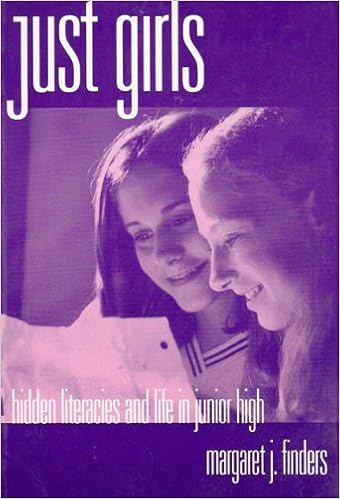
Review: Just Girls by Margaret Finders

           
In order to expand my knowledge of literacy theory, I decided to do some additional reading on the subject. The first book that I chose to read for this purpose was Just Girls: Hidden Literacies and Life in Junior High by Margaret Finders. For this particular study, Finders followed primarily five girls “in their transition from a self-contained sixth-grade classroom into a traditional junior high setting” (2). These five girls belonged to two different social groups in the junior high. Angie, Lauren, and Tiffany are considered “social queens” while Cleo and Dottie are “tough cookies”. The “social queens” are described as the popular girls while the “tough cookies” are considered the good students while also not active participants in the social aspects of junior high. The primarily focus of following these five women for Finders is to find more about the literacy habits of the junior high aged female.  What is really interesting about focusing on these two specific groups is that their literacy activities are completely different. For example, the “social queens” live for the opportunity to sign yearbooks for those deemed worthy to have this privilege. On the flip side, the “tough cookies” do not get to participate in that activity because their families cannot afford a luxury like a yearbook that will only have the standard picture of their daughters. Finders also delves into these girl’s literacy identities. For example, Angie is the stereotypical “smart” one amongst the “social queens”. Therefore, Angie not only has to keep her grades up, but she has the responsibility to sell her papers to her friends in order to keep her social status. Cleo, one of the tough cookies, grew up in an environment full of books which allowed her to escape her life.
Finders does an excellent job of showing how all five of the girls interact differently with literacy. It also makes me want to explore this genre of girl literacy further. After all, females have a much different view of literacy than males do, which largely develops in junior high. Since females have always been stereotyped with being "Chatty Cathys", I would love to see if these conversations are tied to their ideas of literacies. If you are interested at all in literacy or junior high studies, I highly recommend checking this book out. In fact, I would love to see a more modernized version of this book that includes how these junior high school girls expand their literacies from the use of the Internet or social media. I would also love to see a book where Finders return to these five girls later to see how their ideas of literacy has changed or stayed the same.If you know of any studies in that field, please let me know.
Works Cited
Finders, Margaret J. Just Girls: Hidden Literacies and Life in Junior High. New York: Teachers College, 1997. Print

Monday, September 21, 2015

Disabled Literacy?

            I thoroughly enjoyed reading “What No Bedtime Story Means: Narrative skills at Home and School” by Shirley Brice Heath. In this particular article, Heath analyzes the home literacies of families from three communities: Maintown (just the average American town), Roadville (a predominately white town that thrives on a mill), and Trackton (a predominately black town that thrives on a mill). While doing her research, Heath was focusing on how these three communities define certain childhood events. Although the full article is interesting, one area in particular really caught my attention. While talking about Maintown, Heath discusses the “Maintown ways”, which Maintown kids “were expected to learn….in these nuclear households” (52). Although these literacy steps would be great for a child who was considered “normal," what about those who were not or could not be considered “normal." I am talking about personal experience here because I did not speak until I was 3 or 4. As a result, despite the fact that I was basically reading when I started to talk, I would be behind according to these “Maintown ways." For example, I would not be able to “announce [my] own factual and fictive narratives” (Heath 53) because I was not able to talk.

            Deriving from my personal experience, I went down the rabbit hole of thinking about how the definitions of literacies would differ from those who suffer with disabilities that would disrupt their normal development. After all, those are visually impaired would not be able to “give attention to books” (Heath 52) because they cannot see the book or literacy material and those who are deaf cannot “listen and wait as an audience” (Heath 53) to a book. I do not want to be hard on Heath’s research: after all, it was published in 1982 and the field of disability studies was still in its infancy. But, this is a crucial lapse in Heath’s research that is so glaring to me. I had to do some primitive research into how those afflicted with disabilities define literacy and was able to find a good website called Perkins Learning. This website offers plenty of resources for those looking to improve the literacy skills of people with disabilities. According to this website, “literacy may call for options other than Braille or print” (“Literacy Students Multiple Disabilities Deafblindness”). Maybe the openminded nature that allows for multiple literacies also expands the definition for literacy. I guess the biggest takeaway from doing this little bit of thinking and research was that I want to keep looking into this. That way, more literacy theorists can realize that their research is not encompassing for everybody.

Work Cited
Heath, Shirley Brice. "What No Bedtime Story Means: Narrative Skills at Home and School." Lang. Soc. Language in Society 11.01 (1982) 49-76. Web. 

Monday, September 14, 2015

Do You Dual Credit?

            Throughout Chasing Literacy, I have constantly been reminded of my high school literacy experience. So much of what these case study students have been saying was what I would have said at seventeen. Another grim example of how this case study mirrored my real life was the idea that college composition courses could actually be taught in high school. According to Kristine Hansen and Christine Farris, these courses are rendered “appropriate to move into the high school to speed up student development and make room in college for other kinds of learning” (qtd. in Keller 84). It would be an understatement to say that I have problems with their assertions. First of all, Hansen and Farris feel that the high school classroom is “appropriate” for an accelerated version of a college composition class. When I think of college composition courses, I do not always think of a safe and watered-down environment like the high school classroom. From my high school experience, I never had a class that would have translated well into a college classroom. After all, these college courses taken in high school (often known as dual credit classes) can feel like they are watered down since they have to meet the college standards for a high school mind. Also, these dual-credit classes have to be available to every student that wants to take it, not just those who would do well in these classes. So, a rigorous college course gets translated to become an ordinary high school class that will get the student college credit. Thus, the college composition course is no longer the same thing. The second issue I have with Hansen and Farris is the fact that they are implying that composition courses are not a necessary component to college learning. Now, I understand and agreed with the line of thought that some people need to learn writing skills in high school, but I still think that college composition courses can help learn other skills that are necessary. I know that I have taught how to write an email, register for classes, and drop classes to students on top of writing an argumentative essay for the appropriate audience and crucial researching skills. By saying these classes can be taught in the high schools, people are limiting the options for first year students to become more engaged in the collegian atmosphere.

Any other problems with the Hansen and Farris quote? Or, do you agree with the Hansen and Farris quote?

Works Cited
Keller, Daniel. Chasing Literacy: Reading and Writing in an Age of Acceleration. Logan: Utah State UP, 2013.