Monday, November 23, 2015

Production vs. Connection

As a composition teacher, I often wonder if my style of teaching is the best style for my students. In my department, we are encouraged to stress to our students that writing is not about the product, but about the process. While having a great initial product is fantastic, it is not realistic for every student to produce a wonderful and original piece of work. So, by pushing them to think in this way, students should be able to see their writing styles change a little bit through the semester. But, is that actually a good thing?
            According to Stuart Selber, my way of thinking would be associated with the “paradigm of production”. According to him, this paradigm “ teachers embrace process models and even the social turn that the discipline has taken, yet they ultimately expect students to produce a thoroughly original text, one in which their own…ideas and words become the discernable anchor of the discourse” (Selber 135). In other words, teachers expect originality while also at the same time urging them to interact with the real world. As a result, these students could be thinking that originality has no place in the world of academic writing.
            As an alternative, Selber discusses the “connection paradigm”. This particular paradigm allows people to “focus on reorganizing and rerepresenting existing (and equally intertextualized) texts—their own included—in ways that are meaningful to specific audiences” (Selber 135). A potential assignment for Selber would be writing a “hypertext that interprets and arranges relevant discussions of copyright for teachers of writing and communication” (135-6). So, with this line of thinking, teachers are allowing students to use original thought to figure out certain packets of information could be connected with each other.
            So, why aren’t more teachers using assignments that fall within the “connection paradigm”? I think it is because other disciplines are not encouraging them to think in that way. English/Composition is responsible for teaching the college writing, so the university believes that we have to teach it a certain way that can translate to multiple majors and schools of thought. Even though teaching writing with computers would be extremely beneficial to multiple students, that is not what we are there for. We are there to teach them how to do research and write academic papers and that’s it. That is why the process method still lingers in the composition world—because we are being hemmed in by the other disciplines. Until they see the purpose of doing a more interactive idea of writing, we will be teaching the basics.


Work Cited

Selber, Stuart A. Multiliteracies for a Digital Age. Carbondale: Southern Illinois UP, 2004. Print.

Sunday, November 15, 2015

The Impact of Constructivism on Literacy in a Computer-Free Classroom

           As I have discussed in multiple blogs on here, I do not have the privilege this semester of teaching in a classroom with computers for student access this semester. In a composition class, not having computers can be deadly especially if the department wants teachers to have in-class workdays to work on upcoming projects. I also know that I have students who do not own a laptop to bring to class, so that also becomes its own special issue. So, I struggle with showing students how to do certain elements on the computer when they do not have their own computers.
            That means that I fall in line with, at the very least, Stuart A. Selber’s definition of constructivism. According to him, this pedagogy “is a philosophy of learning based on the premise that learning is an active process in which students construct new knowledge based upon their current/previous knowledge” (76). In other words, I expect my students to be a participant in their own learning process. Even when I am lecturing from grammar PowerPoints, I want my students not only feel comfortable but also feel encouraged to ask questions about what I am teaching. So, when they are silent, it makes me feel like they do not care about what I am teaching, which is extremely disappointing to me as a constructivist teacher.
            So, how does my idea of constructivism impact specifically computer literacy in a computer-free classroom? A great way that I use this concept is if my students have in-class assignments that could be completed by using the Internet; I let them use either the Internet or their cell phones or other device that can access the Internet. That way, they can see that these devices that they use every single day (especially cell phones) can be used in an academic setting. By doing this assignment, students are able to combine the literacies they have gained throughout their educational careers along with the literacies they have gained from using cell phones and other electronic devices for so long. I am still working on strengthening this process, but so far it has worked really well in my classes. Are there any other suggestions to help me?
Work Cited

Selber, Stuart A. Multiliteracies for a Digital Age. Carbondale: Southern Illinois UP, 2004. Print.

Sunday, November 8, 2015

Review: Instant Identity by Shayla Thiel Stern


          So, in order to continue my own individual exploration of the fields of literacy and girls studies, I decided to read yet another book in this field. I chose Instant Identity: Adolescent Girls and the World of Instant Messaging by Shayla Thiel Stern. In this particular book, Stern looks at the Instant Messaging that several girls of different races, socio-economic classes, and religions partake in. Throughout the book, Stern highlights how these young ladies construct their identities through these online interactions with their friends. For example, one of the participants in the case study can have a deep and introspective conversation about Christianity with one of her church camp friends but then also have a flirty and playful chat with a guy that she likes. Stern also explores how services like AOL Instant Messenger exploit these young women in order to promote their own business.
            Unfortunately, this book has several flaws. First of all, Stern has very limited interactions with them, so she is heavily relying on the self-perceptions of the subjects instead of her own developed perception of them. Secondly, Stern barely acknowledges any other way of instant messaging. She does mention texting but drops it quickly because it is still novel at the time. Because of this lack, Stern’s book feels extremely dated even though it is only 8 years old. Finally, because Stern focuses on so many girls in this study, these girls do not have much characterization. I spent so much time while reading this book flipping back and forth to the introduction of these girls, so I can make sure that I knew who was who.
            Although this book doesn’t focus as much on literacy as I thought it would, I can still see it being beneficial to my own research. After all, this research shows how young girls and their literacies can be impacted by online pressure. If you don’t know the hip IM slang, you are noted by others as being inexperienced. I would love to see Stern do a more focused and updated version of this research, but instead of focusing on IM, she should focus on texting and emoji language. After all, more young women and girls do texting than IMing these days anyway.

Work Cited

Stern, Shayla Thiel. Instant Identity: Adolescent Girls and the World of Instant Messaging. New York: Peter Lang, 2007. Print.

Sunday, November 1, 2015

Why Having Computers is Important to Teaching Composition

            For two out of the three years I have been teaching college composition, I have been fortunate enough to have spent at least one class day a week in one of my department’s computer labs. Having this access to computers was great because I was able to give time for the student’s individual exploration of their writing or their research instead of assuming that my students have their own laptops or tablets. This year, I didn’t get so lucky because I ended up teaching Writing II, which isn’t taught in a computer classroom at my university. As a result, I feel like I haven’t been nearly as effective with developing a better computer literacy. My feeling is probably shared by many college composition teachers as a survey conducted in the early 2000s shows “that only 25 percent of the graduate teaching assistants in rhetoric and composition programs have an opportunity to teach writing in a computer-based classroom” (qtd. in Selber 7). Of course, this survey is dated, but I’m sure that many teachers are still in my situation. So, although Selber says that this lack to direct computer access shouldn’t be a barrier in teaching composition, but why can it be?
            I have two basic theories. The first theory is that students don’t have the time or the ability to have the direct interaction with the computers. In the past, I have taught how to do basic research and then allowed them to have some time to do their own research on the university’s computers. Without that ability, I am expecting them to listen to me teach and then go home and remember everything. That is just not realistic for even the most overachieving student. The second theory is that students just don’t see how applicable these computer skills are without actually getting the opportunity to test those skills out. English and composition are often seen as not important because they are not “applicable” in their lives, which is not true. We, as composition teachers, have to push our students to see that despite computers, we can still learn more about composition. However, I dread that with today’s technology-minded students, not teaching composition with computers could be the death knell for the modern composition classroom. Hopefully, composition departments will learn that lesson sooner rather than later.


Work Cited
Selber, Stuart A. Multiliteracies for a Digital Age. Carbondale: Southern Illinois UP, 2004. Print.

Monday, October 26, 2015

The Abilities of the Computer Literate Student

In his introduction for Multiliteracies for a Digital Age, Stuart A. Selber discusses several questions that should be on the forefront of the minds of composition teachers as technology continues to progress. One of these questions is “What should a computer literate student be able to do?” (Selber xi). This particular question got me to thinking about what are my expectations of computer literacy in my own composition classroom. In fact, I worry that I have too high of expectations for these students that I don’t explain in thorough detail how to do what I consider basic computer knowledge. A prime example of this idea is when I had to explain to my students how to attach files to emails by the using the paper-clip icon in Microsoft Outlook. What I thought was common sense was proven to be wrong. So, I decided to list the three basic abilities that in my head would count towards computer literacy. They are, to me:
  • Computer literate people should know the basics of operating a computer. I don’t expect many to know coding lingo, but I do expect them to know how to turn on a computer, charge it, and turn it off without asking for help. They also know how to mess with basic controls on the computer like sound and volume.
  • Computer literate people should be able to use some form of word processing software in order to type. In line with that, people should be able to save, print, and edit their work. This particular aspect of computer literacy would be this most relevant to the composition classroom because it shows that they can write papers using technology.
  • Computer literate people should be able to know how to access the Internet. Not only does this theory apply to what web browser to use, but also that people know how to check email, search for basic information, and keep in contact with friends along with other Internet skills.

Some may notice that I did not bring up other digital devices like cellphones and tablets. That is because most of the same aspects of basic computer literacy could apply to other forms of digital literacy. To me, there is not much difference. Do you agree?
Work Cited
Selber, Stuart A. Multiliteracies for a Digital Age. Carbondale: Southern Illinois UP, 2004. Print.

Thursday, October 15, 2015

Voice in Written Work

I know that I have written the following comment on many a student work: “I can/can’t hear your voice in your writing.” Although this may sound idiosyncratic to non-composition teachers, it makes perfect sense to me. After all, students who try to write in a pseudo form of academic prose can often sound like they are “faking it.” Luckily, one of the foremost figures in composition studies agrees with me. According to Peter Elbow, “The best writing has voice: the life and rhythms of speech” (189). Without these needed “rhythms of speech”, the writing feels stilted and not representative of the student’s best work. For example, imagine if there is a composition student who wants to write an argumentative paper about abortion. Although abortion is an overdone topic, the student may be able to bring their own perspective to the paper through two different avenues. The first one is that they can show their view of the abortion debate along with the research skills in order to build a compelling argument. The second one is that they have the writing skills to communicate that argument. Without one of these, the other one cannot bring the paper to the position that it needs to be. So, if the student is writing without “the life and rhythms of speech”, this paper will come across as fake and not truly expressing what the student is meaning to say. Instead, the paper will potentially read like a regurgitated abortion debate instead of a fresh take on a fairly dead topic.
            So what can composition teachers do in order to help with increasing more voice in written work? It’s extremely simple. Show them that using their voice isn’t wrong but necessary to take a stronger responsibility to one’s work. Increasing one’s voice may make your writing more vulnerable and risky, but it can also heightened the writing and argument. Yes, “inventing the university” is still important, but so is “the life and rhythms of speech”. One just has to find the right balance between the two.

Work Cited

Elbow, Peter. “The Shifting Relationships Between Speech and Writing.” Landmark Essays on Speech and Writing. Ed. Peter Elbow. New York: Routledge, 2015. 181-200. Print. 

Sunday, October 11, 2015

The Perceptions of Literacy in College Students

     After finishing Chasing Literacy by Daniel Keller, my eyes were opened wide by how today’s students have to be able to adapt in using multiple literacies in the classroom or risk the chance of being left behind by an education system that swore against that very practice. Throughout this fantastic case study, Keller details the successes and struggles that students can have when literacy not only has multiple meanings but also has multiple practices. In the conclusion, Keller notes how “perceptions affect what people do with literacy” (161). I have to agree with that assertion from personal and teaching experience. Before taking a class in literacy theory, I had the naïve belief that literacy just related to reading books and writing academic papers and short stories. However, that is not all that we read and write. Every day, we read and write text messages, social media posts, and television listings, not to mention all of the reading and writing that is needed for school purposes. But, this quote, along with the rest of Keller’s work, got me to thinking about how my own students would respond. After all, I teach upperclassmen that would not fall into the same trap that I did, right?
            So, I decided to ask my students two very simple questions. The first one was “What do you read on a regular basis?” The second one was “What do you write on a regular basis?” I was clear that I would not aid them in answering these questions, because I did not want to lead them into answers that would prove Keller correct or incorrect, thus rendering this “experiment” invalid. But, there was no reason because they answer as Keller predicted. According to the majority of these students, the only thing that they read is textbooks and other school materials and the only thing they write is papers and other homework assignments. Some of them mentioned texts and social media, but not all of them did. When I brought this up and asked why they did not mention the other “non-academic” literacies, they said that they were writing down what they thought I wanted to read. Imagine their shock when I reminded them that I just wanted to know what they read and write on a regular basis.
            What does this all mean? It means that in this ever-changing world, people do not realize how much we read and write. It also means that they have more chances to improve their reading and writing skills along with other abilities that will allow them to become better readers and writers. So, as a teacher, I will have to work on constantly reminding them that they read and write more than what they think they do. I will also do a better job of bring multiple literacies into the classroom in order to make learning how to write better more grounded in reality.
Do you have any tips for me?


Works Cited
Keller, Daniel. Chasing Literacy: Reading and Writing in an Age of Acceleration. Logan: Utah State UP, 2013


Monday, October 5, 2015

"Paying Attention" to Technology

While reading Cynthia Selfe’s “Technology and Literacy: A Story about the Perils of Not Paying Attention”, I was struck by many of Selfe’s findings about how privileged certain groups are to have the luxury of developing technological literacy. However, the one line in the article that caused me to start thinking about my role that was when Selfe argues that “composition studies faculty have a much larger and more complicated obligation to fulfill—that of trying to understand and make sense of, to pay attention to, how technology is now inextricably linked to literacy and literacy education in this country” (414). I hadn’t thought much about how my use of technology could increase the technological literacy divide in my classroom. Sure, there have been circumstances when my students have struggled with technology that I assumed that they wouldn’t have. For example, last fall I had to do a tutorial about how to send emails with attachments after a few students complained that they couldn’t figure out how to send their projects to me.  But, I thought this wasn’t the norm. However, once again I was proven wrong about one of my assumptions about teaching college composition and that there will be many students who struggle with technology.
                After all, the make-up of college students is very diverse, so naturally the make-up of technological literacy is going to be diverse. For example, I will have students who have not only grown up using the Internet but have actively been taught in using it properly for a long period of time alongside students who had their first experience using the Internet when they first started college. So, many people are going to ask, “How do we pay attention to technology and literacy in regards to teaching?” I think there are two big steps to paying attention. First of all, listen to what your students are having issues with. If it is something basic, like email or PowerPoint, take time after class or during your office hours to help that particular student out on an individual basis. Otherwise, you will have students complaining about how elementary this problem is. But, if the issue is more advanced, then maybe you can make a lesson in order to help bridge the gaps of literacy. Secondly, do more lessons that deal with writing using technology. For example, I am having my student write an appropriate email to a college instructor this week for a journal assignment.  That way, they can learn not only the proper way to communicate to an authority figure, but they also can get more familiar with the proper standards of writing an email. By doing this particular step, you are still teaching composition, but you are also teaching technology.
                Do you have any feelings about our lack of “paying attention” to technology?
Work Cited

Selfe, Cynthia L. “Technology and Literacy: A Story about the Perils of Not Paying Attention.” College Composition and Communication 50.3 (1999): 411-436. Web. 

Sunday, September 27, 2015

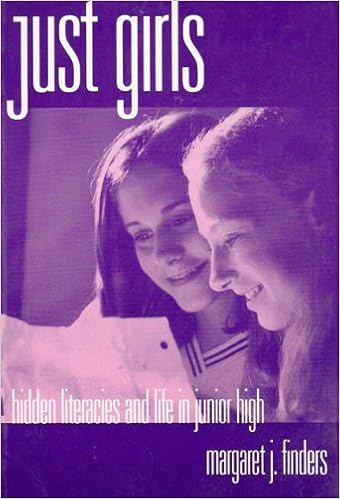
Review: Just Girls by Margaret Finders

           
In order to expand my knowledge of literacy theory, I decided to do some additional reading on the subject. The first book that I chose to read for this purpose was Just Girls: Hidden Literacies and Life in Junior High by Margaret Finders. For this particular study, Finders followed primarily five girls “in their transition from a self-contained sixth-grade classroom into a traditional junior high setting” (2). These five girls belonged to two different social groups in the junior high. Angie, Lauren, and Tiffany are considered “social queens” while Cleo and Dottie are “tough cookies”. The “social queens” are described as the popular girls while the “tough cookies” are considered the good students while also not active participants in the social aspects of junior high. The primarily focus of following these five women for Finders is to find more about the literacy habits of the junior high aged female.  What is really interesting about focusing on these two specific groups is that their literacy activities are completely different. For example, the “social queens” live for the opportunity to sign yearbooks for those deemed worthy to have this privilege. On the flip side, the “tough cookies” do not get to participate in that activity because their families cannot afford a luxury like a yearbook that will only have the standard picture of their daughters. Finders also delves into these girl’s literacy identities. For example, Angie is the stereotypical “smart” one amongst the “social queens”. Therefore, Angie not only has to keep her grades up, but she has the responsibility to sell her papers to her friends in order to keep her social status. Cleo, one of the tough cookies, grew up in an environment full of books which allowed her to escape her life.
Finders does an excellent job of showing how all five of the girls interact differently with literacy. It also makes me want to explore this genre of girl literacy further. After all, females have a much different view of literacy than males do, which largely develops in junior high. Since females have always been stereotyped with being "Chatty Cathys", I would love to see if these conversations are tied to their ideas of literacies. If you are interested at all in literacy or junior high studies, I highly recommend checking this book out. In fact, I would love to see a more modernized version of this book that includes how these junior high school girls expand their literacies from the use of the Internet or social media. I would also love to see a book where Finders return to these five girls later to see how their ideas of literacy has changed or stayed the same.If you know of any studies in that field, please let me know.
Works Cited
Finders, Margaret J. Just Girls: Hidden Literacies and Life in Junior High. New York: Teachers College, 1997. Print

Monday, September 21, 2015

Disabled Literacy?

            I thoroughly enjoyed reading “What No Bedtime Story Means: Narrative skills at Home and School” by Shirley Brice Heath. In this particular article, Heath analyzes the home literacies of families from three communities: Maintown (just the average American town), Roadville (a predominately white town that thrives on a mill), and Trackton (a predominately black town that thrives on a mill). While doing her research, Heath was focusing on how these three communities define certain childhood events. Although the full article is interesting, one area in particular really caught my attention. While talking about Maintown, Heath discusses the “Maintown ways”, which Maintown kids “were expected to learn….in these nuclear households” (52). Although these literacy steps would be great for a child who was considered “normal," what about those who were not or could not be considered “normal." I am talking about personal experience here because I did not speak until I was 3 or 4. As a result, despite the fact that I was basically reading when I started to talk, I would be behind according to these “Maintown ways." For example, I would not be able to “announce [my] own factual and fictive narratives” (Heath 53) because I was not able to talk.

            Deriving from my personal experience, I went down the rabbit hole of thinking about how the definitions of literacies would differ from those who suffer with disabilities that would disrupt their normal development. After all, those are visually impaired would not be able to “give attention to books” (Heath 52) because they cannot see the book or literacy material and those who are deaf cannot “listen and wait as an audience” (Heath 53) to a book. I do not want to be hard on Heath’s research: after all, it was published in 1982 and the field of disability studies was still in its infancy. But, this is a crucial lapse in Heath’s research that is so glaring to me. I had to do some primitive research into how those afflicted with disabilities define literacy and was able to find a good website called Perkins Learning. This website offers plenty of resources for those looking to improve the literacy skills of people with disabilities. According to this website, “literacy may call for options other than Braille or print” (“Literacy Students Multiple Disabilities Deafblindness”). Maybe the openminded nature that allows for multiple literacies also expands the definition for literacy. I guess the biggest takeaway from doing this little bit of thinking and research was that I want to keep looking into this. That way, more literacy theorists can realize that their research is not encompassing for everybody.

Work Cited
Heath, Shirley Brice. "What No Bedtime Story Means: Narrative Skills at Home and School." Lang. Soc. Language in Society 11.01 (1982) 49-76. Web.